The Stone Reader by Peter Catapano & Simon Critchley
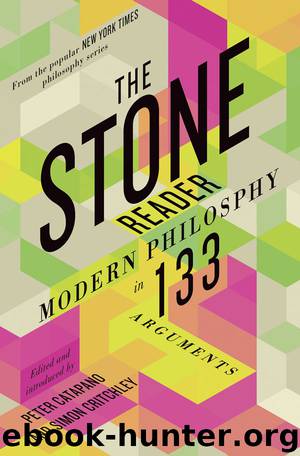
Author:Peter Catapano & Simon Critchley
Language: eng
Format: epub
Publisher: Liveright
Published: 2015-12-06T16:00:00+00:00
THE UNITED STATES IS A RELIGION-OBSESSED COUNTRY. SINCE its founding by English Puritans in the early seventeenth century seeking a safe haven from persecution, the country has been the destination for wave after wave of immigrants trying to protect and cultivate their own distinctive varieties of religious practice and experience. The core value of the settlement and ever-Westering expansionism of America has been the claim to religious freedom, which has found expression in both extraordinarily imaginative religious poetry and bloody violence. Once here, settlers and immigrants didn’t just adapt their existing faith to the new environment, but often created entirely new forms of religious life and enthusiasm, from the Shakers to the Mormons to the Scientologists.
It was perhaps to be expected that much of the writing and debate in The Stone should find its focus in religion, the experience of faith and in questions of the latter’s legitimacy or illegitimacy. The appearance of The Stone coincided with both the high-water mark and receding of the tide of the so-called New Atheism, of figures like Richard Dawkins and Christopher Hitchens, whom Terry Eagleton playfully combined into the novel creature called “Ditchkins.” Such “Ditchkinsianism” was particularly evident in many of the readers’ comments over the years, as were any number of vigorous defenses of religious belief or claims to spirituality.
In the first two parts of this third section, “What Is Faith?” and “The Varieties of Religious Disagreement,” the reader will find an array of defenses of the experience of faith, all the way to the argument that faith might not even require some metaphysical belief in the existence of God. Also on display in a powerful manner are discussions of the nature and limits of religious toleration, with particular relation to the question of blasphemy as it arises in Islam’s troubled location in the Western, secular world. Also, a series of essays provides some welcome and possibly surprising insights on the nature of Judaism and its relation to Israel and the fraught question of Zionism.
In “Morality’s God Problem,” the reader will find a fascinating set of discussions of one of the most frequently debated questions in The Stone: Does the practice of morality require religious faith and the existence of God? Or, on the contrary, must morality be conducted independently of any foundational religious claims? Where exactly should one draw the line between the sacred domain of religion and the humane experience of moral reflection? Is God necessary for goodness? Or is belief in a deity an obstacle that stands in the way of the choices of our allegedly autonomous selves?
Many people have never had the good fortune to take a philosophy class in school or college. But if they have, then it is probable that the class was called Introduction to Ethics or Moral Philosophy or even Applied Ethics. Philosophy is often at its best, sharpest, and most disturbing when working through the difficulties provoked by competing moral theories in relation to real-life issues like abortion and euthanasia. In the final
Download
This site does not store any files on its server. We only index and link to content provided by other sites. Please contact the content providers to delete copyright contents if any and email us, we'll remove relevant links or contents immediately.
The remains of the day by Kazuo Ishiguro(9086)
Tools of Titans by Timothy Ferriss(8493)
Giovanni's Room by James Baldwin(7436)
The Black Swan by Nassim Nicholas Taleb(7197)
Inner Engineering: A Yogi's Guide to Joy by Sadhguru(6836)
The Way of Zen by Alan W. Watts(6672)
The Power of Now: A Guide to Spiritual Enlightenment by Eckhart Tolle(5854)
Asking the Right Questions: A Guide to Critical Thinking by M. Neil Browne & Stuart M. Keeley(5832)
The Six Wives Of Henry VIII (WOMEN IN HISTORY) by Fraser Antonia(5558)
Astrophysics for People in a Hurry by Neil DeGrasse Tyson(5224)
Housekeeping by Marilynne Robinson(4504)
Double Down (Diary of a Wimpy Kid Book 11) by Jeff Kinney(4335)
12 Rules for Life by Jordan B. Peterson(4331)
Ikigai by Héctor García & Francesc Miralles(4311)
The Ethical Slut by Janet W. Hardy(4308)
Skin in the Game by Nassim Nicholas Taleb(4307)
The Art of Happiness by The Dalai Lama(4169)
Skin in the Game: Hidden Asymmetries in Daily Life by Nassim Nicholas Taleb(4051)
Walking by Henry David Thoreau(4002)
